How the Tradition Thinks
You can translate the Torah. You can’t translate the Hebrew.
Hebrew mostly grows from three-letter roots. Words that look unrelated in translation are one family in Hebrew — and the Torah is woven from that. A translation hands you the picture and quietly drops the music.
01The spark
A Hebrew word is rarely a word by itself. Three letters carry a core idea, and whole families grow out of them — much as in Arabic — so words that look like strangers in translation stand openly as kin on the page. The Torah leans on this again and again: meaning doesn’t sit in the sentence alone, it hums underneath it, in the roots.
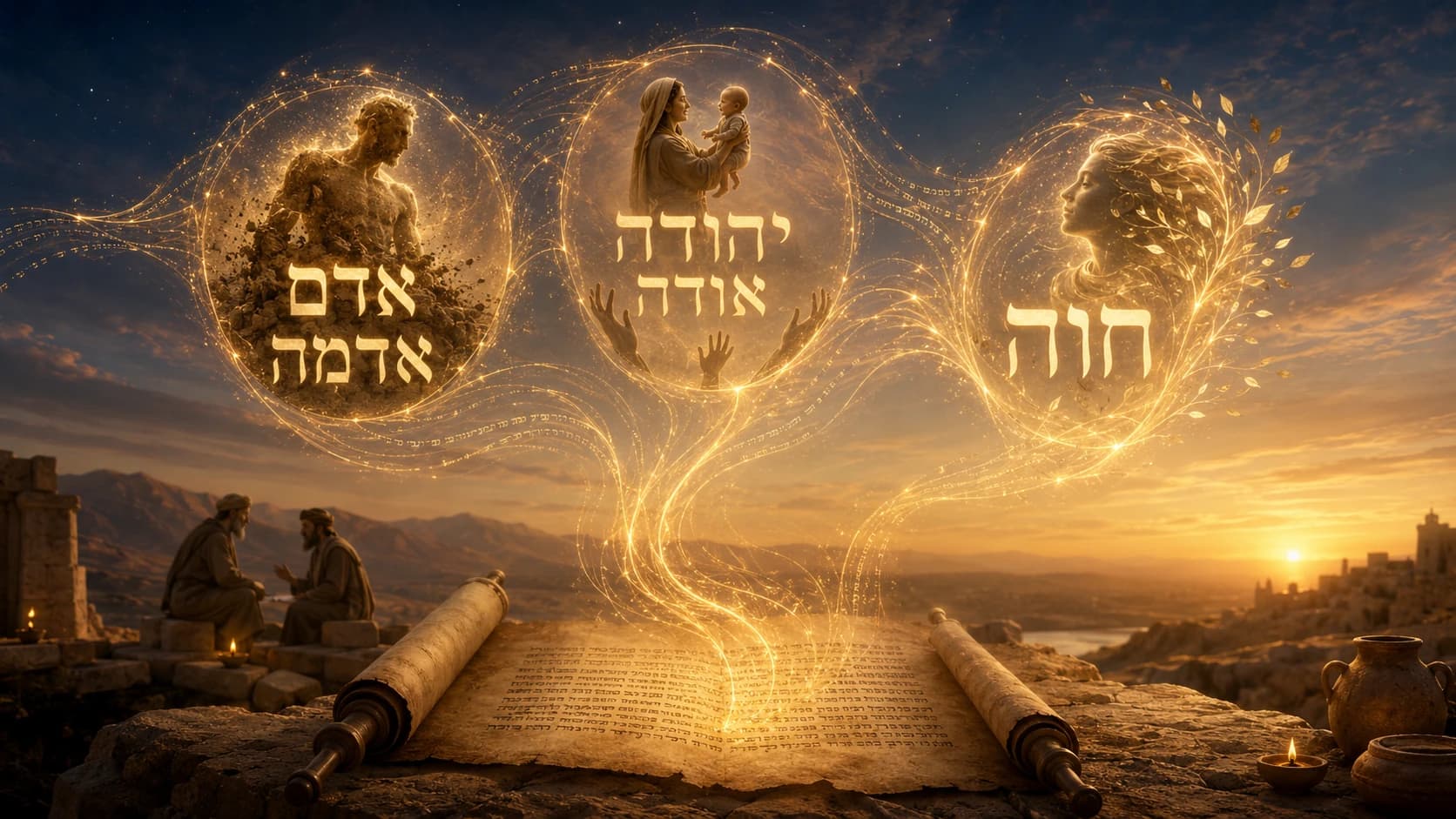
When Leah bears her fourth son she cries ha-pa’am odeh — “this time I will give thanks” — and names him Yehudah. Odeh and Yehudah are built from one root, י־ד־ה, to thank and to acknowledge. The name is the sentence folded shut: she sealed her gratitude inside her son. In translation you read “I will praise the Lord… so she called him Judah,” and the two halves no longer touch — you’re told she named him, but not why the name is the prayer.
And it’s everywhere. The Torah calls the first human ha-adam because he is formed from ha-adamah, the ground: adam means “human,” adamah means “ground,” and in Hebrew you hear one inside the other — the name itself says “the one taken from the earth.” In English, “human” and “ground” are strangers, and the link is gone. The first woman is Chavah — Eve — named in the same breath “the mother of all the living,” and her name is built from chai, “living”; in English, “Eve” and “living” share not a single letter. These aren’t decorations: the Torah tells you what a thing is through its name, and that telling lives in the sound of the Hebrew.
None of this is a sign on the door that says “Hebrew only.” Read the Torah in your language — it is a real doorway, and millions have walked through it. Just know there is a room behind the door. The tradition has been awake to this for two thousand years: it warned that a flatly literal translation “falsifies” a verse, while one who adds to it “reviles and blasphemes” — and so it joined every text to a living teacher who hands on how it is read, which is why, to this day, you learn Torah with someone, not from a book alone.
This rests on what came before
This rests on a spark you may have met — that the Torah was never only a written text; a spoken teaching was carried alongside it. The same holds inside each word: the letters on the page are only part of it, and the meaning lives in the Hebrew that breathes them.
02Where this comes from
In Judaism this rests on the texts themselves. Here are the receipts — look them up.
Genesis 2:7
Then the Lord God formed the human from the dust of the ground.
The original Hebrew
וַיִּיצֶר יְהֹוָה אֱלֹהִים אֶת־הָאָדָם עָפָר מִן־הָאֲדָמָה
Go deeper
The first human is ha-adam, formed from the dust (afar) of ha-adamah, the ground. Adam means “human” and adamah means “ground”: one root, two words — the man’s very name says what he was made from, as if English had named him “Earthling” because he was taken from the earth. “The human… from the dust of the ground” is true in any language; that the human and the ground he is drawn from share a single root is true only in Hebrew.
Genesis 3:20
The man named his wife Eve, because she was the mother of all the living.
The original Hebrew
וַיִּקְרָא הָאָדָם שֵׁם אִשְׁתּוֹ חַוָּה כִּי הִוא הָיְתָה אֵם כׇּל־חָי
Go deeper
He calls her Chavah — Eve — and the verse gives the reason in the same breath: ki hi hayetah em kol chai, “for she was the mother of all the living.” The verse links her name to chai, “living”: the name and the reason rhyme, bound to the role it gives her. In translation “Eve” carries none of this; in Hebrew you can hear life inside the name.
Genesis 29:35
She conceived again and bore a son and said, “This time I will praise the Lord”; so she named him Judah.
The original Hebrew
וַתַּהַר עוֹד וַתֵּלֶד בֵּן וַתֹּאמֶר הַפַּעַם אוֹדֶה אֶת־יְהֹוָה עַל־כֵּן קָרְאָה שְׁמוֹ יְהוּדָה
Go deeper
Leah’s cry is ha-pa’am odeh — “this time I will give thanks” — and from odeh she shapes the name Yehudah. They are one root, י־ד־ה, to thank and to acknowledge. The name is the sentence folded shut: she sealed her gratitude inside her son. Read “I will praise the Lord… so she called him Judah” in any other tongue, and the two halves no longer touch — you are told she named him, never why the name is the prayer.
Kiddushin 49a
One who translates a verse to its literal form falsifies it; and one who adds to it reviles and blasphemes.
The original Hebrew
הַמְתַרְגֵּם פָּסוּק כְּצוּרָתוֹ הֲרֵי זֶה בַּדַּאי, וְהַמּוֹסִיף עָלָיו הֲרֵי זֶה מְחָרֵף וּמְגַדֵּף
Go deeper
Asked what it means to “read and translate” the Torah, the Sages cite Rabbi Yehuda on the twin dangers: render a verse by its bare literal form and you falsify it; add your own gloss and you “revile and blaspheme” — tampering in the other direction. They were not against translation — they used one every week — but they knew no rendering is the thing itself. So they bound the text to a living teacher who hands on how it is read. Two thousand years ago, the tradition already knew the page alone could not carry all of it.
The chain
Three times the Hebrew names a thing by its root — human from the earth, Eve from life, Judah from thanks — and the Sages, reading those very verses, declared that no flatly literal translation can carry them. The language is not disposable wrapping around the meaning; it carries the meaning with it.
03The turn
So when someone says “I’ve read the Torah,” the gentle truth is: you’ve met it through a translation — a true and faithful drawing, but one that can’t keep every color. The Torah doesn’t hide itself out of pride. It is simply written in a language that carries much of its meaning in its music — and to hear that music you eventually have to learn the song, or sit beside someone who can sing it to you.
04Take it with you
One spark, its sources, ready for the group chat.
You can translate the Torah — you can’t translate the Hebrew.